What port work actually buys
Power in a four-stroke is airflow turned into pressure, and the cylinder head is where that conversion happens. On a 450cc single working from 7,000 to 11,500 RPM, correct port and chamber work adds six to ten percent in peak airflow. The more valuable gain is a wider usable band — the engine pulls through the gears instead of only at the top.
Head work multiplies the package around it. It cannot rescue a cam timed for the wrong RPM band or an exhaust that chokes at peak lift. Teams that port last, after cam and compression are settled, get more from the same budget than teams that port first.
There is also a structural side. Removing material near the exhaust throat or across a water jacket wall shortens the head’s life even while the flow sheet improves. Port work starts with wall-thickness measurement, not with a cutter.
Where the gains are — and where they are not
Bigger is the wrong target. Mixture flows because of velocity and direction, so an oversized port slows the charge at low and mid RPM and costs the torque you use between corners. The goal is the smallest port that flows the required volume at your target RPM.
| Port region | What it controls | Typical target |
|---|---|---|
| Valve seat throat | Most of the flow at low and mid lift | 86–90% of valve diameter |
| Short-side radius | Flow attachment at high lift | Generous, blended radius — no sharp turn |
| Port entry / mid runner | Least restriction in the system | Uniform 120–180 grit finish on intake |
| Exhaust port surface | Carbon adhesion, heat absorption | Smoother finish than the intake side |
| Chamber surface | Hot spots, carbon retention | Fine, even finish, no tool ridges |
CNC versus hand porting: repeatability is the product
A master porter can produce a superb single head. The limitation is identity — the second head interprets the first, and the eighth head in a season interprets an interpretation. For a team that qualifies on one engine and races on another, variation between heads is variation in the product.
CNC porting inverts the economics. Development cost concentrates in the first article — digitizing, flow-bench proof, toolpath refinement — and head number twenty costs machine time. What you buy is the spread: port volumes within a few percent across a batch, chamber volumes within ±0.2 cc, and a mid-season replacement that flows like the one it replaced.
The honest limitation: a machine reproduces a shape, it does not judge one. A mediocre hand-ported original becomes a consistently mediocre program. Development sequence matters more than equipment — flow development first, digitizing second, machining last. Ask any supplier what bench developed the shape, not what machine cut it.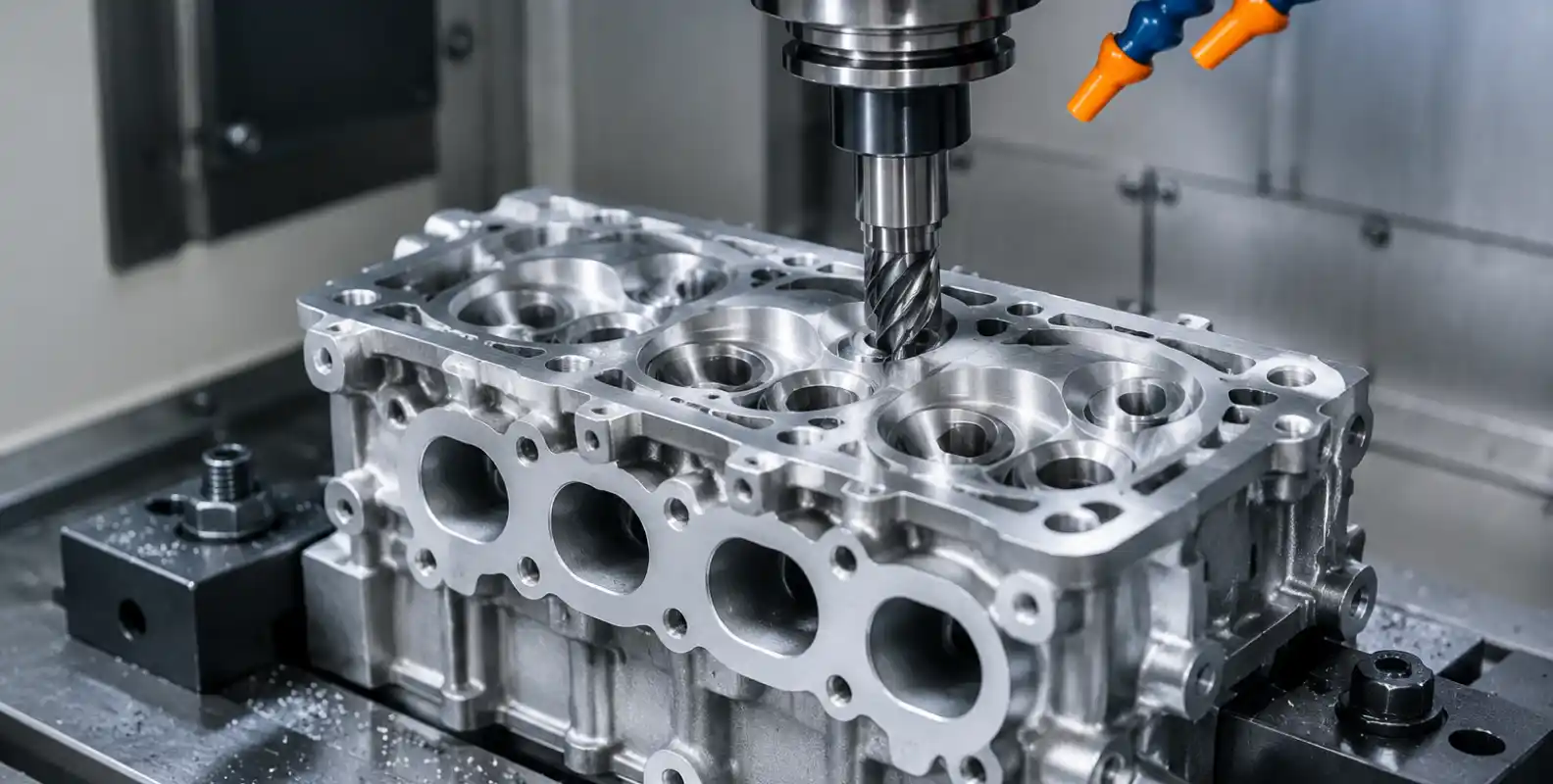
Valves, seats and guides for high-RPM duty
At 11,000 RPM a valve cycles more than ninety times per second and sheds most of its heat through the seat contact. Hardware choice is a survival calculation.
Where the rulebook allows, a 1 mm oversize intake valve adds roughly four percent curtain area at the cost of valve mass the springs must control. Where valves are frozen by regulation — common in production classes — the performance moves to seat geometry. A multi-angle seat job (30° top, 45° seat, 60° throat blend) recovers real low-lift flow without touching a regulated dimension.
For materials we run high-copper-nickel seat alloys that hold hardness at exhaust temperatures, and manganese-bronze guides for wear resistance and heat conduction. Seats and guides are installed and finish-cut in a single setup, so concentricity is fixed in one fixturing. That is what keeps the valve sealing at eleven thousand RPM the way it sealed on the bench.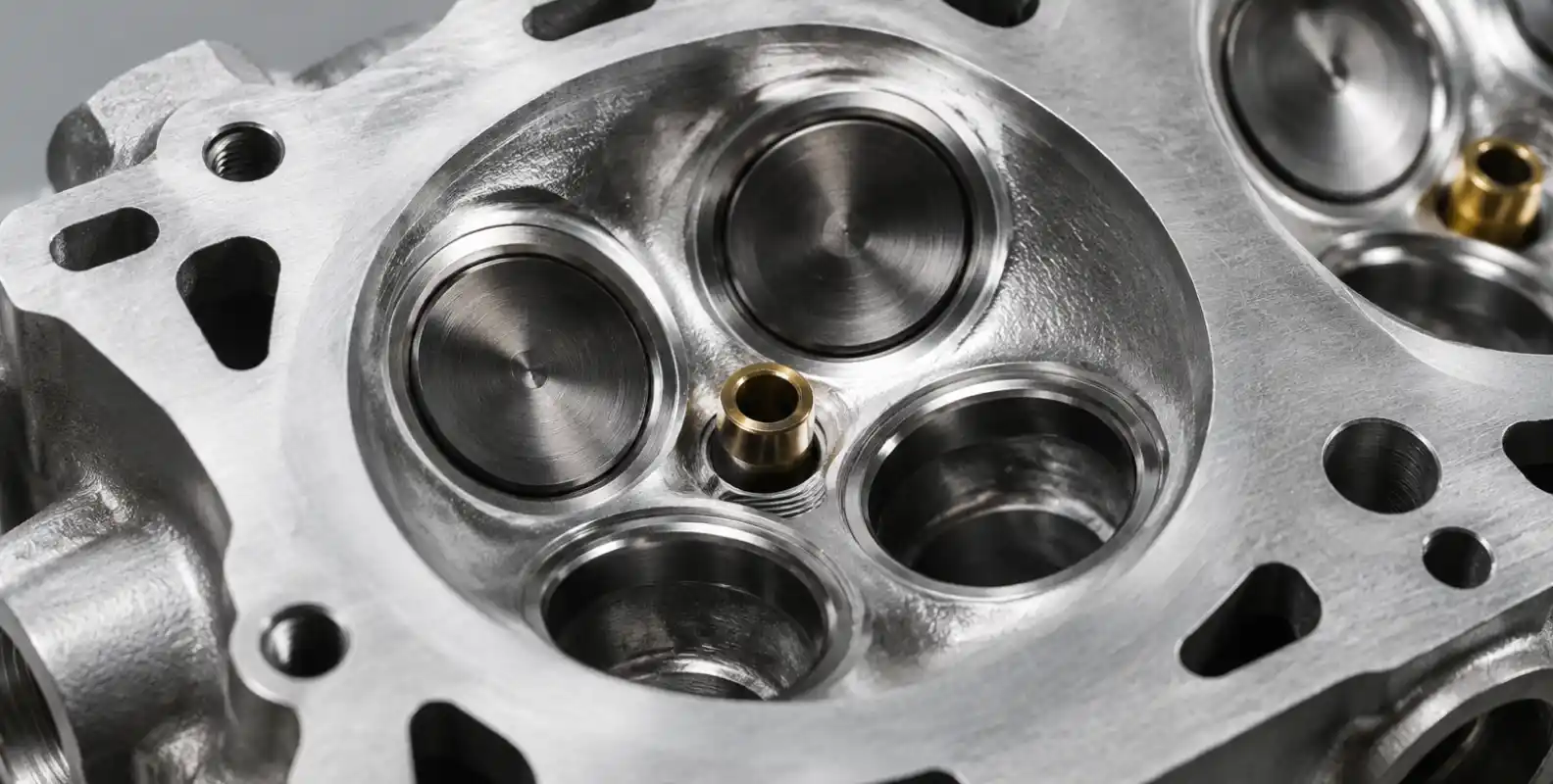
Two-stroke heads: a different problem
Two-stroke race heads contain no ports — the cylinder does the breathing. The head’s job is chamber shape, squish velocity and heat rejection, which makes each variable more sensitive, not less. The practical solution is the insert-type head covered on our KTM aftermarket cylinder heads page: one shell, swappable chamber inserts for different fuels and elevations, and damage isolated to a replaceable insert.
Validation: bench, dyno, track
A ported head passes through three checks. The flow bench verifies the shape against design — flow at each lift point, velocity, cylinder-to-cylinder balance. The dyno adds combustion and shows where the gains landed; a peak gain that hides a midrange loss usually traces back to throat proportion or seat angles, and the fix is rarely more material removal.
The track gives the only binding verdict: lap time, plug condition, piston crown readings after a full moto. Teams that log head temperatures and photograph crowns per batch generate the feedback that improves the next run. A multi-season head program should be treated as iteration — and the measurement records are what make iteration possible.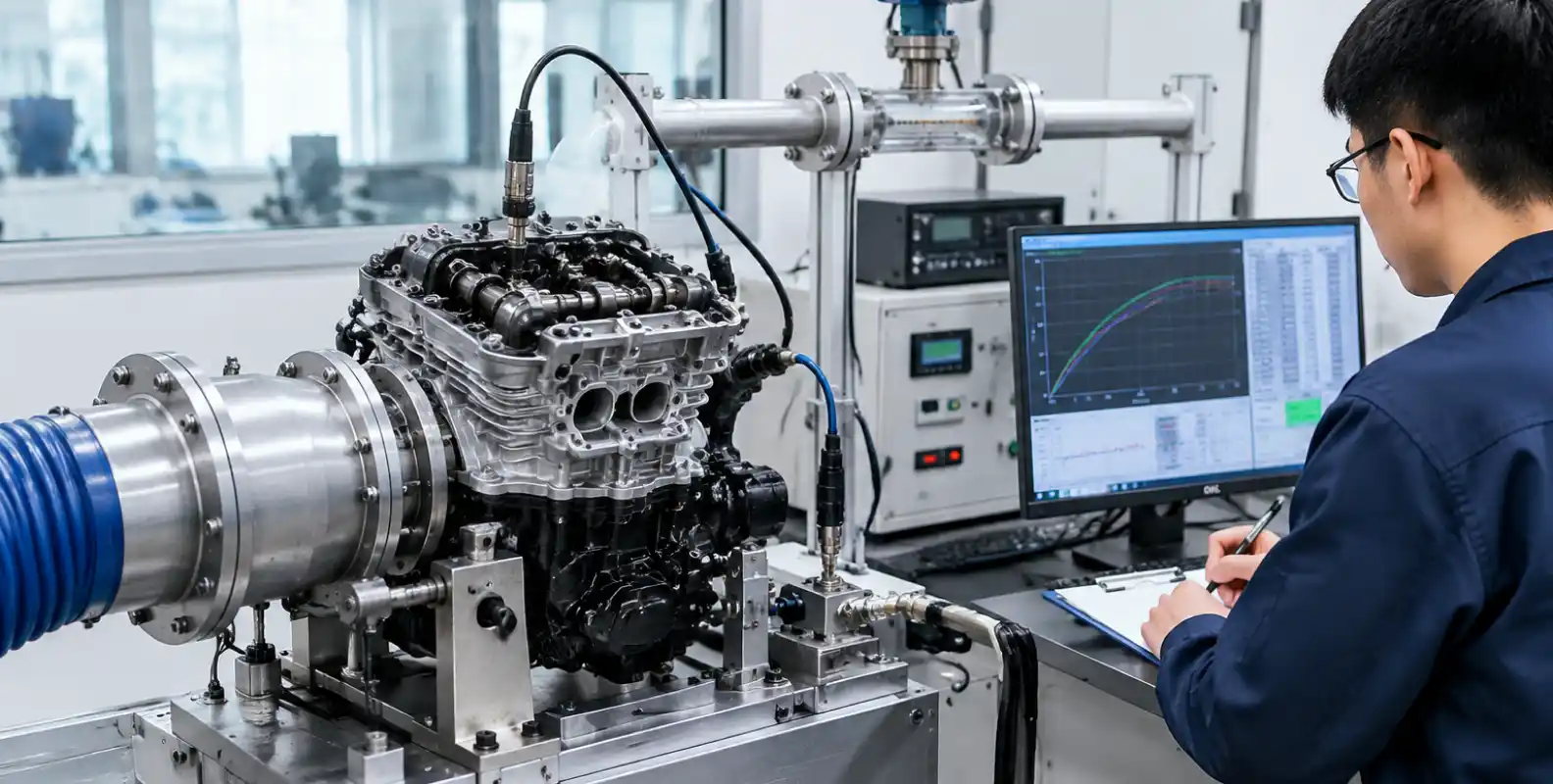
What to send when ordering port work
Three inputs work, in descending order of precision: a proven port shape (developed sample or flow-referenced CAD), a stock head plus a defined target (RPM band, cam spec, fuel, class rules), or a stock head with the target left to us — in which case the brief should say so.
Whatever the input, include the valves and springs you will run, the race gasket, and a sample piston. Development of a new shape runs three to five weeks with flow iterations; production of a proven program runs 15 to 25 days per batch. Heads ship with per-unit port volume and chamber volume records. For multi-cylinder platforms, demand a record per cylinder — a batch report showing one number describes the head the supplier chose to measure. Vintage platforms with their own casting constraints are covered on our classic motorcycle cylinder heads page, and off-road applications on the dirt bike cylinder heads page.
-

Feiya Engineering Team
A dedicated group of manufacturing experts at Feiya Machinery since 2009. With a focus on DFM (Design for Manufacturing) and quality control, our team oversees the production of 5,000+ tons of aluminum castings annually. We share practical insights on tooling, metallurgy, and machining to help global buyers make informed sourcing decisions.