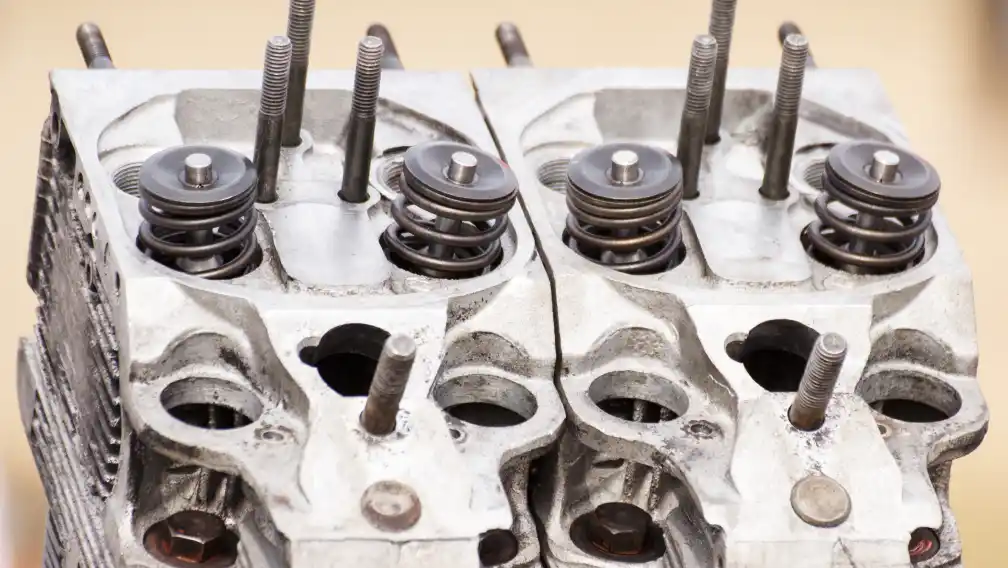
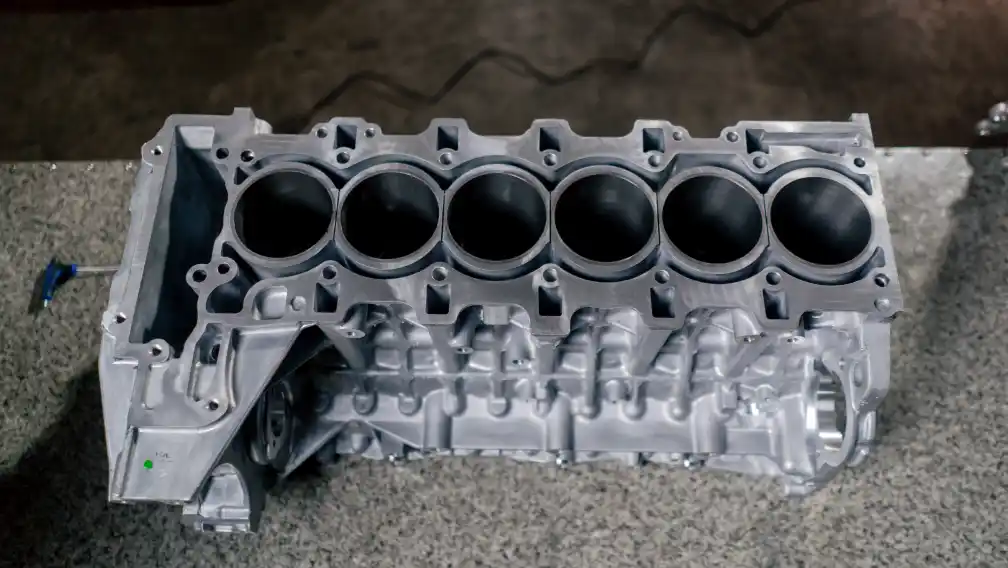
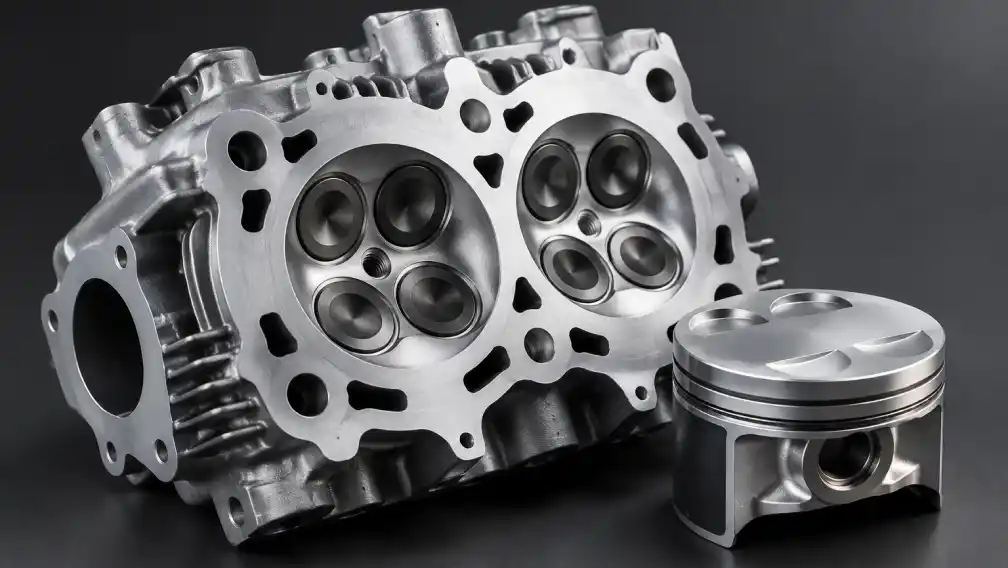
Competition motorcycle engines operate at specific outputs above 130 hp per liter in motocross and past 200 hp per liter in road racing. At those load levels, the cylinder head defines the mechanical ceiling of the engine. Port orientation, valvetrain geometry, combustion chamber symmetry, and cooling jacket density dictate volumetric efficiency, peak engine speed, and fatigue life under sustained thermal cycling.
Each major racing manufacturer has converged on a distinct cylinder head architecture to solve packaging, mass centralization, and airflow constraints. For aftermarket performance brands, race engine builders, and OEM tier suppliers, reproducing or upgrading these castings requires aligning foundry metallurgy and machining tolerances with the exact mechanical demands of each platform. This technical brief examines the dominant racing cylinder head architectures across five major brands, details their measurable performance characteristics, and outlines the casting, heat-treatment, CNC machining, and verification standards Feiya applies to produce competition-grade performance cylinder heads.
Racing Cylinder Head Architectures Across Major Motorcycle Brands
Modern four-stroke racing platforms diverge sharply in camshaft placement, valve actuation, and port layout. Understanding these platform-specific geometries is a prerequisite for tooling design, core-box engineering, and finish machining.
Honda: Unicam SOHC and High-RPM Superbike DOHC
On its motocross and enduro platforms such as the CRF450R, Honda uses its Unicam single-overhead-camshaft (SOHC) layout. A single camshaft sits directly over the intake valves and actuates them via finger followers, while a forked rocker arm operates the exhaust valves. This geometry reduces overall cylinder head height and top-end mass, lowering the motorcycle's center of gravity while preserving a steep, direct downdraft intake angle. Modern CRF450R heads run compression ratios up to 13.5:1 with tight squish clearances to accelerate flame propagation. On road-racing platforms like the CBR1000RR-R, Honda shifts to a compact DOHC finger-follower layout engineered for rev ceilings past 14,500 rpm. Sourcing or reproducing castings across these configurations requires strict cam-bore alignment and narrow valve-angle tolerance control, as detailed across our Honda cylinder heads range.
Yamaha: Reverse-Head Forward Intake Layout
Yamaha's YZ450F and YZ250F motocross platforms invert conventional four-stroke packaging by placing a straight, forward-facing downdraft intake port at the front of the head and routing the exhaust port rearward. Combined with a rearward-slanted cylinder, this reverse-head geometry delivers cool, high-velocity air directly from a front-mounted airbox into multi-angle oval intake ports fitted with large titanium valves. Mass concentrates closer to the chassis pivot, improving cornering agility while keeping exhaust heat away from the intake tract. From a manufacturing standpoint, reverse-head castings introduce asymmetric thermal gradients across the exhaust side and complex sand-core paths for the coolant jacket surrounding the rear exhaust port. Precision casting and port consistency for these platforms are central to our Yamaha cylinder heads program.
KTM: Compact SOHC 450 and High-Revving DLC Finger-Follower DOHC
KTM separates its competition cylinder head designs by displacement class. The 450 SX-F relies on an ultra-compact SOHC head with 40 mm intake valves and 33 mm exhaust valves actuated by lightweight rocker arms, placing the camshaft close to the engine's center of gravity for rapid throttle response and strong mid-range torque. In contrast, the 250 SX-F and 350 SX-F utilize DOHC heads with diamond-like carbon (DLC) coated finger followers driving large titanium valves (32.5 mm intake / 27.5 mm exhaust on the 250 SX-F; 36.3 mm / 29.1 mm on the 350 SX-F). These small-bore racing heads operate at compression ratios up to 14.5:1 and engine speeds exceeding 13,400 rpm, demanding rigid bolted camshaft bearing bridges and high-integrity head gasket sealing surfaces. Platform coverage for these Austrian race architectures is documented on our KTM cylinder heads page.
Kawasaki: World Superbike-Derived Finger-Follower DOHC
Kawasaki transferred its World Superbike finger-follower DOHC valvetrain from the Ninja ZX-10R directly into the KX450 motocross engine. Replacing bucket tappets with lightweight finger followers cuts reciprocating valvetrain mass by roughly 20 percent, allowing steeper camshaft lobe profiles, higher valve lift, and elevated rev limits without valve float. Because finger followers rely on precise pivot geometry and minimal lateral clearance, the machined bosses, oil feed galleries, and valve guide concentricity inside the casting must hold tight positional tolerances under thermal expansion. These machining requirements govern production across our Kawasaki cylinder heads catalog.
Suzuki: Balanced DOHC Flow Stability and Endurance Durability
Suzuki's RM-Z450 and GSX-R1000 cylinder heads prioritize predictable port velocity, broad mid-range torque, and long-interval thermal stability. Using a traditional DOHC four-valve architecture with carefully proportioned wall thicknesses around the combustion dome and spark plug boss, Suzuki heads resist deck warping and valve-seat recession during extended moto or endurance stints. Consistent wall thickness in the casting stage and uniform residual stress relief during heat treatment are essential to preserving that structural stability across aftermarket replacements in our Suzuki cylinder heads lineup.
| Brand | Representative Race Platforms | Cylinder Head Architecture | Primary Performance Characteristic | Key Manufacturing Demand |
|---|---|---|---|---|
| Honda | CRF450R, CBR1000RR-R | Unicam SOHC / Superbike DOHC | Low center of gravity, high compression (up to 13.5:1) | Compact valve-angle machining and cam-bore alignment |
| Yamaha | YZ450F, YZ250F, YZF-R1 | Reverse-head DOHC (forward intake) | Direct downdraft airflow, mass centralization | Complex rear-exhaust water-jacket cores, port symmetry |
| KTM | 450 SX-F, 350 SX-F, 250 SX-F | Compact SOHC (450) / DLC finger-follower DOHC (250/350) | 13,400+ rpm capability, 14.5:1 compression on 250cc | Stiff bearing-bridge datums, MLS gasket deck flatness |
| Kawasaki | KX450, Ninja ZX-10R | WSBK-derived finger-follower DOHC | Reduced reciprocating mass, aggressive cam profiles | Tight follower pivot tolerances and oil-gallery accuracy |
| Suzuki | RM-Z450, GSX-R1000 | DOHC 4-valve performance layout | Broad mid-range flow, high thermal fatigue endurance | Uniform casting wall density, stress-free T6 aging |
Core Performance Characteristics of Competition Cylinder Heads
Across all five brand architectures, the measurable performance gains of a racing cylinder head come down to three engineering fundamentals: airflow efficiency, valvetrain stability at high rpm, and combustion control under extreme thermal loads.
Volumetric Efficiency and High-RPM Breathing
Power output scales directly with the mass of air-fuel mixture trapped in the cylinder before ignition. Competition cylinder heads maximize volumetric efficiency through high-tumble downdraft intake ports that accelerate charge velocity without inducing flow separation around the short-side radius. Precision multi-angle valve seat profiles—typically combining 30-degree, 45-degree, and 60-degree cuts—smooth the transition from port throat to combustion chamber and maximize low-lift flow. Even a 0.3 mm core shift between raw casting ports can create measurable cylinder-to-cylinder power imbalance on multi-cylinder road racers. Detailed airflow modeling and port-transition control are covered in our engineering brief on port and chamber reshaping for high-RPM motorcycle engines.
Valvetrain Rigidity and Mass Control
At 14,000 rpm, each valve opens and closes over 116 times per second. Controlling valve bounce and seating velocity requires minimizing reciprocating mass—through titanium valves and finger-follower actuation—while keeping the cylinder head structure rigid enough to hold camshaft bearing alignment under spring loads. Excess flex in the cam towers or bearing caps disrupts hydrodynamic oil films, accelerating journal wear and altering effective valve timing. High-performance castings pair thin external walls with internal ribbing around cam-cap bolt bosses to achieve high stiffness-to-weight ratios.
Combustion Stability and Thermal Endurance
High-compression racing engines operate close to the detonation threshold. Uniform combustion chamber volume—typically held within ±0.2 to ±0.5 cc—ensures consistent static compression across production batches and multi-cylinder banks. Precisely contoured squish bands push end-gases toward the central spark plug, shortening burn duration and reducing knock sensitivity, a relationship examined in our guide to compression ratio and squish design. Simultaneously, exhaust valve bridges experience peak heat flux exceeding 300 °C. Dense, void-free aluminum around the exhaust ports and unobstructed internal cooling passages are required to pull heat away from the valve seats and prevent thermal cracking, as analyzed in our thermal management documentation.
How Feiya Supports High-Performance Racing Cylinder Head Manufacturing
Translating competition-grade design intent into repeatable batch production requires tight integration between foundry engineering, heat treatment, multi-axis CNC machining, and metrology. Feiya structures its manufacturing workflow around the metallurgical and dimensional thresholds required by racing dirt bike cylinder heads and high-output street platforms.
Alloy Selection, Gravity Casting, and T6 Heat Treatment
Structural racing cylinder heads require low-porosity aluminum alloys capable of sustaining high thermal cycling without fatigue cracking. While high-pressure die casting with ADC12 serves air-cooled commuter heads and covers (detailed on our aluminum die casting page), liquid-cooled racing heads are gravity-cast using A356 aluminum alloy (JIS AC4CH / ZL101A). The metallurgical trade-offs between these alloys are documented in our ADC12 vs. A356 cylinder head alloy comparison.
Before pouring, molten A356 undergoes rotary degassing and spectrometer composition verification to control silicon and magnesium levels. Sand-core assemblies form the complex internal water jackets and downdraft ports, and directional solidification minimizes shrinkage porosity in thick sections near the valve bridges. Castings then move through full T6 heat treatment—solutionizing, controlled water quenching, and artificial aging—to elevate yield strength, stabilize dimensional geometry, and establish uniform Brinell hardness before final machining begins.
Multi-Axis CNC Machining and Concentricity Control
Raw castings are finished across a dedicated facility operating more than 125 three-, four-, and five-axis CNC machining centers. Five-axis simultaneous machining allows combustion chambers, port entries, and angled valve-guide bores to be referenced from a single primary datum, eliminating tolerance stack-up across multiple fixtures.
Critical race tolerances are held at the final machining stage: valve seat-to-guide concentricity is controlled within ±0.005 mm after seat rings and guides are interference-fitted, ensuring uniform 360-degree valve contact and optimal heat transfer out of titanium exhaust valves. Camshaft journals are line-bored with bearing caps torqued to operating specification. Deck surfaces are fly-cut to flatness limits under 0.03 mm with controlled Ra surface roughness tailored to multi-layer steel (MLS) head gaskets. Full machining sequence specifications are outlined on our motorcycle cylinder head machining and manufacturing capabilities pages.
Inspection, Testing, and Traceability
Competition cylinder heads undergo multi-gate verification prior to release. Optical emission spectrometers confirm melt chemistry per furnace batch. Every liquid-cooled casting passes 100% pressurized air-under-water or pressure-decay leak testing on both coolant jackets and oil galleries to rule out micro-porosity. Hexagon coordinate measuring machines (CMM) audit deck flatness, cam-bore coaxiality, valve seat runout, and combustion chamber profile against master CAD models. Hardness testing verifies T6 temper consistency, and dimensional reports are indexed to production lot numbers in line with our quality certifications and cylinder head batch inspection checklist.
OEM Build-to-Print and Reverse Engineering Pathways
Racing programs and aftermarket distributors enter production with different levels of technical data. Feiya supports two structured engineering pathways through its custom manufacturing program:
- Direct OEM Build-to-Print: Customers provide 3D CAD models (STEP/IGES) and 2D tolerance drawings. Engineering teams run Design for Manufacturability (DFM) and mold-flow simulations to verify wall thickness and thermal feeding before fabricating permanent metal molds and core boxes, followed by First Article Inspection (FAI) sign-off.
- Optical 3D Reverse Engineering: When legacy or discontinued race platforms lack original CAD data, physical OEM or modified competition heads are digitized via high-resolution optical 3D scanning. Engineers reconstruct parametric models with casting shrinkage compensation, optimize port-to-core alignment, and validate prototype flow and fitment prior to series tooling.
Finished heads can be supplied either as bare, fully CNC-machined castings ready for custom race valvetrains or as complete assemblies pre-fitted with valves, springs, retainers, and stem seals.
| Manufacturing Stage | Feiya Process Standard | Direct Impact on Racing Performance |
|---|---|---|
| Alloy & Melting | A356 (AC4CH / ZL101A), rotary degassing, spectrometer check | High thermal conductivity and resistance to valve-bridge cracking |
| Casting & Cores | Gravity casting with precision sand water-jacket cores | Dense, low-porosity structure and consistent port wall thickness |
| Heat Treatment | Controlled T6 solution treatment and artificial aging | High yield strength and deck stability under 13.5:1–14.5:1 loads |
| Precision Machining | 125+ 3/4/5-axis CNC centers; seat concentricity ±0.005 mm | Optimal valve sealing, uniform chamber volume, zero oil-film bind |
| Verification | Hexagon CMM, 100% pressure-leak test, Brinell hardness | Verified drop-in fitment and zero cooling-jacket leakage |
Engineering Support for Racing and Performance Programs
Developing a competitive aftermarket or OEM racing cylinder head starts with validating the casting alloy, core geometry, and datum tolerances against your target engine platform. Contact our engineering team with your STEP/IGES CAD files, 2D drawings, target brand model, or physical sample specifications. We provide DFM feedback, alloy and heat-treatment recommendations, tooling lead times, and batch quotation options for both bare castings and fully assembled performance cylinder heads.
-

Feiya Engineering Team
A dedicated group of manufacturing experts at Feiya Machinery since 2009. With a focus on DFM (Design for Manufacturing) and quality control, our team oversees the production of 5,000+ tons of aluminum castings annually. We share practical insights on tooling, metallurgy, and machining to help global buyers make informed sourcing decisions.